Actros
Long Distance / Distribution
Actros
Efficiency | Reliability | Safety
Multimedia Cockpit
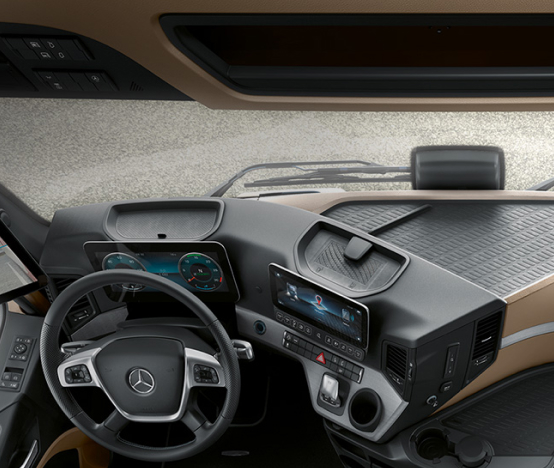
The Actros features the innovative Multimedia Cockpit for enhanced driving comfort, ergonomics and ease of operation. The new, state-of-the-art workplace comprises four screens in all. The primary colour display and the secondary Multi-Touch-Display, can be operated via the new multifunction steering wheel with Touch Control Buttons. The high-resolution primary colour display replaces the conventional instrument cluster and offers a clearly arranged presentation of all vehicle and operating statuses and vehicle information.
The secondary Multi-Touch-Display comprises an integrated radio infotainment system and facilitates handling of functions such as heating/air conditioning, telephony and interior lighting. In addition, various body functions can be controlled with the Multi-Touch-Display via switches and indicator lamps which can be displayed on the screen. Numerous connection options for mobile devices further enhance ergonomics and ease of operation. Everything can be operated intuitively and is precisely tailored to the driver’s work procedures. The attractive colour concept, the high-quality materials and the developed beds are further assets providing that extra touch of work motivation.
MirrorCam
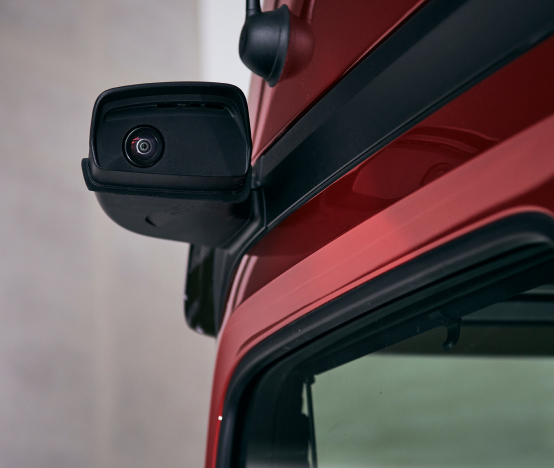
Besides cutting fuel consumption by up to 1.3%, it provides an ideal view rearward and around the area of the A pillar. In addition, the MirrorCam improves safety, for example by automatically panning the camera image when manoeuvring, turning corners or changing lanes. The camera system comprises two high-resolution fold-up cameras that are mounted on the upper roof frame. The camera images are sent to two 15.2″ (38.6 cm) colour screens near the A pillar. To aid the driver in assessing the traffic behind him/her, the respective screen shows tracking and distance indicator lines as soon as he/she switches on the indicator at a speed greater than 30 kilometres per hour. Warnings alerting the driver to excessively tight turning angles add yet more assistance during manoeuvring.
Improves safety, by automatically panning the camera image when manoeuvring, turning corners or changing lanes. Improved view of the road across the A pillar as view no longer obstructed by large mirrors (at roundabouts, for example). Greater safety when cornering thanks to tracking lines on-screen and coloured pull-in areas displaying to help keep safe distance to vehicles behind when pulling back in after overtaking when the indicators are switched on. Greater safety thanks to distance indicator lines aiding in assessment of rearward traffic and improved view of trailer.
Predictive Powertrain Control (PPC)
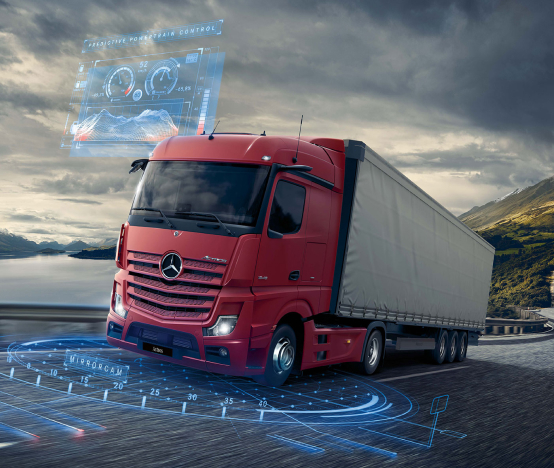
Predictive Powertrain Control (PPC) allows you to operate even more economically because the system always knows the route ahead. It knows your route from start to finish. The system integrates a driving style optimised for the route topography into the operation of the automatic transmission and, in conjunction with the precisely coordinated shift strategy.
Using satellite-based positioning technology and maps, PPC identifies the course of the road and any downhill and uphill stretches ahead. The data provides the basis for the optimization of the shift points, gear steps and the set cruise control speed. The kinetic energy of the vehicle is used as far as possible to avoid unnecessary acceleration, shifting or braking.
Active Brake Assist 5 (ABA 5)
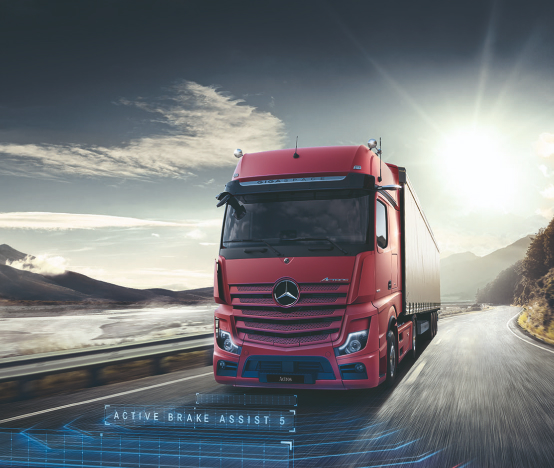
The fifth generation of the system assists the driver in that, under ideal conditions and within the system’s capabilities, it can perform emergency braking when approaching stationary and moving objects, and perform partial or full braking for moving pedestrians, thus mitigating or even preventing accidents entirely. Active Brake Assist 5 is an enhancement of Active Brake Assist 4. This generation combines radar and camera. The new sensor fusion has dramatically improved response to moving pedestrians at speeds of up to 50 kilometres per hour.
Active Brake Assist 5 is now capable of applying full braking when encountering pedestrians crossing its path, approaching from the front or walking ahead. The same applies to pedestrians who walk into the vehicle’s path and suddenly stop there. The system obtains the information required by monitoring the traffic as soon as the vehicle starts moving and combining this data with its own vehicle data. For example, it tracks the distances to vehicles travelling ahead and to moving pedestrians, as well as their speeds and positions. The assistance system reacts to vehicles travelling ahead in the same lane and to stationary obstacles in that lane and also to moving pedestrians.
Electronic Parking Brake
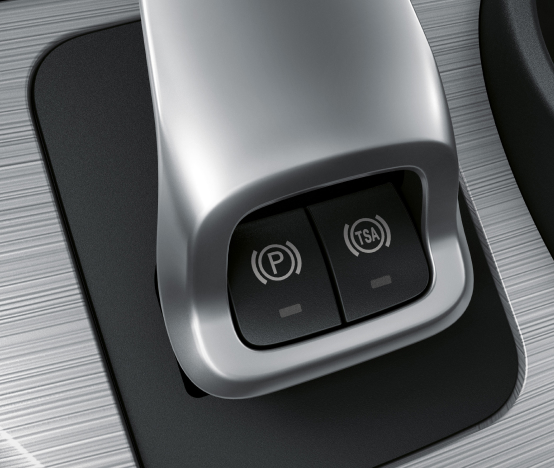
The electronic parking brake replaces the previous parking brake. For even more comfort and safety, the brake is automatically released or applied in certain situations. It is activated automatically on switching off the engine, but can also be switched on and off using the lever in the cockpit.
The integrated HOLD function is activated when the vehicle is at a standstill simply by pressing the brake pedal more firmly, for example at a red traffic light or on an uphill gradient. It is released as soon as the accelerator is pressed again. This avoids the danger of the vehicle rolling back when moving off on an uphill gradient.
Driver Training
Driver development is of the outmost importance in the transport industry.
Vehicle Telematics by Fleetboard
FleetBoard, A Driver and Vehicle Telematics Management System.